
The Pilgrim's Journey, The Human Journey

Hero
This is the usual shape given for the hero’s journey:
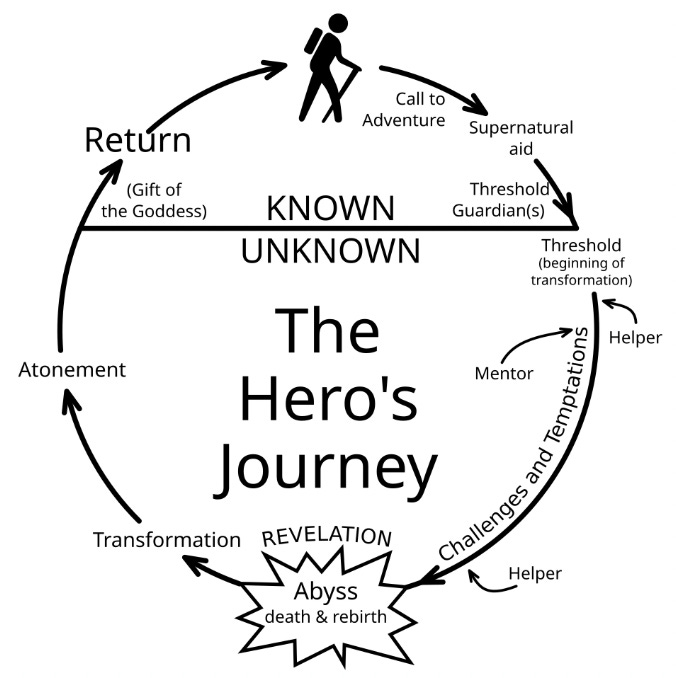
I leave home, cross into something Else, do some things I haven’t done before, and I come back.
Hopefully I integrate the experience before coming back but that’s not guaranteed. People seem to think it’s guaranteed, or automatic somehow.
Which is weird.
Many journeys end without the journeyer having actually integrated it into a benefit for themselves and the home they left. At least not at any layer deeper than the mind, which isn’t nearly deep enough. Seeing something isn’t enough, going through an experience isn’t enough. You have to embody what you’ve seen. You have to become it.
That’s holy. You are not significant just because you see something significant.
— James Hillman, echoing Sonu Shamdasani in conversation about Jung’s Red Book
Let’s stay with James Hillman, talking this time specifically about America 40 years ago — though the America he’s talking about applies well beyond geography now:
My idea about ideas in America is that we burn them up too quickly. We get rid of them by immediately putting them into practice. We only know one thing to do with an idea: apply it; convert it into something usable. And it dies right there in the conversion.
This urge to return and do something with what I’ve seen, what I’ve experienced, what I feel like I know now — it leads to a lot of thrashing, and it’s a disservice to myself and the community.
Bill Plotkin also goes out of his way to make this point, over and over.
After your soul encounter, you might return promptly to your community, in the geographical sense, but you would not return as a person prepared to embody your vision as a gift to your world. You’re not yet ready[…] What must happen first is the reshaping of your Ego into a form capable of carrying that formidable vision.
Look to the diagram up top again. The abyss is at the bottom, and it’s followed by transformation. The abyss itself doesn’t transform you. Soul encounter itself doesn’t transform you. Insight doesn’t transform you. Knowing and seeing — even seeing Truth clearly — doesn’t transform you. Transformation and reshaping of the ego are a different task. And not a trivial or automatic one. Insight can just happen. Breaking down and surrendering can just happen. Transformation doesn’t just happen.
Expect several months of labor. This is the task of actively submitting yourself to being worked on — reshaped — by your vision, by your Soul, by Mystery, by the world, by the Dream of the Earth. Indeed, this could take a few years. Please be patient… but actively patient.
— Plotkin
The journey diagram above can be helpful. I’d argue that the one below adds a more helpful dimension, one that we seem to be squeamish to include in these conversations.
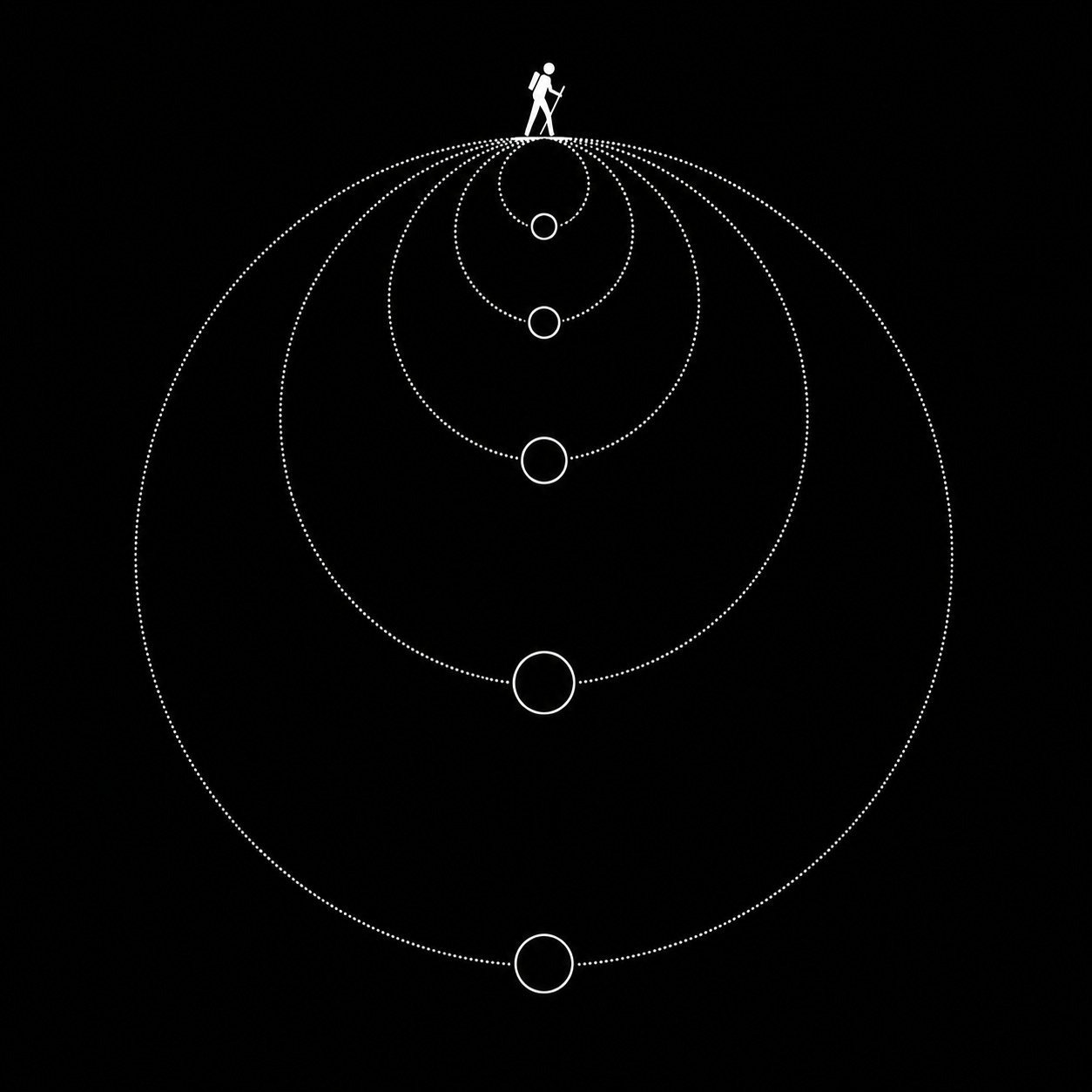
Journeys away from home and into something else — they go to different depths, they go to different lengths. They require different capacities and commitments.
There are different octaves of journeys, and they bring different transformations and boons.
Going to the edge of your capacity and returning is not the same as going beyond your capacity and returning.
Neither of which is the same as going to the edge of hell and returning, which isn’t the same as going beyond hell and returning.
Which isn’t the same as going to the edge of your reality and returning, which isn’t the same as going beyond your reality and returning.
A transformation following a journey that went beyond my capacity takes time, care, effort, surrender, and discernment.
A transformation following a journey that went beyond my reality and the possibilities I thought existed — that takes much more time and much more surrender and much more discernment.
Throughout history and across the world, many different worlds have existed. The world of the local tribe in ancient Europe, the world of the Empire in Chinese dynasties, the world of a large family, the world of a corporation, the world of an institutional bureaucracy, the world of two lovers in 1920s Colombia, the world of a friend group within a punk scene.
When worlds are stable, the heroes’ journeys help to grow and stabilize the world. Its members leave and come back as people with new strength and insight and sensitivity, new offerings to improve that existing world.
These stories and myths of the hero’s journey come from worlds that were stable, homeostatic organisms, able to continue as they were, in their place in the larger world.
We don’t seem to live in a stable world. Things have to change. Leaving home and coming back to the same thing doesn’t always cut it.
I can go into the unknown, and bring something back.
I can go into the unknown, and bring nothing back — if I neglect transformation, or if I use the journey to simply jockey for position in the same world as I left it.
Or,
I can go into the unknown, and bring others with me.
Moana bridges these nicely — she leaves, has her adventure, comes back home… and then brings her people out with her to find new homes, new worlds.
When the old world isn’t working, the best boon you can bring back is the gift of not being stuck there. Of not continuing to pretend it’s working.
Pilgrim
The word pilgrim comes from roots for “beyond” and “field.” A pilgrim is one who either comes from beyond the local fields, or who leaves and goes beyond the local fields. A foreigner, a wanderer — and through later usage, a devotee.
A hero is always of a place. A hero to someone, for something. A hero belongs to a particular world.
A pilgrim doesn’t belong to an existing world. A pilgrim is a wanderer. A pilgrim is devoted to a world they haven’t seen yet — but one they can feel calling them.
I drew a Rumi quote as a frontispiece for my journal as a teen:
My soul is from elsewhere, / and I intend to end up there.
Something about the transformation phase: about how that phase can be skipped — not integrating the insights, neglecting to become them — or it can be deepened, surrendered into very deeply. There’s a dial here, from 0 to 10. I can refuse transformation, if I don’t take the time and steps to do it well — if I assume that just having gone through the journey is enough.
Or I can fully transform, deeply becoming the insights that have been entrusted to me. Or I can turn the dial between those poles, to a 3, a 7, whatever.
One way of being a pilgrim, I think, is to know that my soul is from elsewhere — and to become that place so deeply that it pours off of me, wherever I am. To embody the frequency and rasa of that place so fully that it can’t help but take shape around me, wherever I go.
At one depth of journey and transformation, a pilgrim or a hero can become a new set of emotional responses and possibilities; the way they act in the world they return to becomes a model, a frequency that others can attune to; it can make new things possible between them, make impossible responses ordinary.
Or they can become some insight, embody some new wisdom, new way of seeing. That view can spread to the people around them. Make an impossible way of seeing ordinary.
There’s a unique possibility when pilgrims — those who goes beyond the field and may or may not return where they came from — go on a very deep journey, and dedicate themselves to a very deep transformation from that journey. The pilgrims can become not just a new vision or new responsiveness — they can become a new world; can embody not just improved ways of being within the incumbent reality, but can actually embody a new reality.
It feels like seeing someone operate under a new physics. Like gravity doesn’t apply, or like light behaves differently around them. They assume things are possible that you know to be impossible. And then you watch them do it anyway, and you learn the meaning of impossibility.
My feeling of “Home” isn’t a place, or an end-state, or a goal — it’s simply the natural course of my soul.
When the multidimensional oceanic field of my Being finds a natural, easeful equilibrium — without inflation, without deflation, without clenching, without forcing, without shoulds or musts, without propping anything up or shoving anything down, without ignoring or being blind to the endless sensory field of reality, and the places it goes far beyond what any of us are prepared to believe is real — when it is in a natural, simple, direct, un-efforting posture... that’s Home. The place where wholeness and naturalness meet.
My life is a pilgrimage Home.
The hero’s journey returns home; the pilgrim’s journey returns Home.
In the hero’s journey, it’s possible to return home without undergoing transformation.
In the pilgrim’s journey, transformation is itself the journey Home.
Fear
On every journey, I have the choice of when to turn back. When to say “okay, that was as far as I’m going, time to start heading home.”
The journey wants a certain trajectory — and it allows me to sense that trajectory, that desire. But I’m not required to stay with it the whole way. As Ortega Y Gasset wrote,
Our will is free to realize or not to realize this vital design which we ultimately are, but it cannot correct it, change it, abbreviate it, or substitute anything for it.
We are free not to realize the vital design that we are. We can always turn back early.
Last time I wrote about the hero’s journey, I wrote that the contemporary problem with the journey is that almost everyone gets stuck. We don’t complete the journey. We don’t die — which is a functional necessity of the journey.
In this essay’s frame, I might say that people get stuck by completing an abridged journey, rather than the deeper one that wanted to happen. They turn back and return home with a minor boon, instead of the gift they were meant to find and become. Or they turn back home, when what they were meant to do was complete a pilgrimage onward.
Years ago, I read a book of essays on post-conventional adult development. Levels of maturation beyond the average. There are certain levels of adult development that most people never reach — and then there are people who, based on the tests and surveys, seem to be well beyond even those upper reaches. People who are hard to classify because there aren’t enough of them to compare with each other.
When interviewed, a common fear came up among these people. It’s shape was something like this:
I can feel ways that I could mature farther than I have — but I stop myself from going that direction. It’s already a little lonely, feeling like my loved ones can’t really meet me where I am, that I have to stoop down a bit to meet them where they are. If I go further, I’m scared I’d be completely unrelatable, much more alone.
Etymologically, “afraid” comes from “a-” or “ex” meaning “not” or “out of”; and “-fraid,” which shares a root with “friend.”
To be afraid is to not have a friend. To be unmet.
In a world like ours, I think there’s a border you can either cross or not. The border has something to do with becoming not just unrelatable, but unmarketable.
It feels a bit overdramatic to say that crossing the border feels like going into exile — but I don’t think it actually is overdramatic.
I can’t count the number of times some version of this discussion has come up, in a variety of shapes.
“It feels like x might be true — but if I become a person who believes and lives by x, it would be impossible, wouldn’t it? Where would I work? How would I pay rent? Who would love me?”
“Some people get overcooked and start believing things like x, or thinking that x is more than a metaphor or something. It’s really important to stop before you start believing that, remember to come back to the Real World and work with what’s actually here.”
“Hey, I’ve started living by x and I’m really scared, can you help? It feels like I can’t go back from this… but it also feels like I don’t know what’s ahead. I feel like I’m dying sometimes. What do I do?”
That last one seems important. “It feels like I’m dying.”
When I go into this, I am dying, in some ways. In important ways. The parts of me that couldn’t cross the border are dying. The voices in me that think that in order to survive, I have to be relatable and marketable and accepted in the old world-view — those voices die. And they don’t die easy. They beg me to turn back, to end the journey and go home.
The problem is, I think people listen to those voices, buy into their view. There’s something about the nature of this world-border that makes it much harder to cross than similar borders in other times.
It feels related to this quote from Bill Plotkin:
Arrested human development is modernity’s actual intended outcome (because egocentric consumer-conformist society is not possible in communities of mature humans)."
There’s a border that any healthy culture wants its denizens to cross — a border into responsive, responsible adulthood. Into being fully human. Our own culture, however, is by nature adolescent — if too many people cross into true adulthood, the culture dies.
And so the culture, just like those of us who constitute it, cuts the journey short and turns back early.
We all conspire in fear. We are afraid.
To be afraid is to not have a friend.
This is the worry of the pilgrim.
If you return home at the end of your hero’s journey, you have some level of assurance that your old friends will still be there. Specific friendships may need to change or end, but that’s a softer thing than the prospects of a pilgrim.
The pilgrim goes somewhere new, with no idea who will be there, if they will be friendly, if they will accept the pilgrim.
Or the pilgrim may go somewhere where no one else lives yet. They may have to set the place up alone, isolated, before going out on another journey to find those who want to share the place. —Will anyone want to come? Will they be friendly? Will this new world find citizens who love it?
The worries are real. They can’t be dismissed.
But the old world is falling apart. Staying within its borders out of fear becomes more and more tragic over time.
Me and my friends, stranded in a desert plaza, huddled around the square, watching the children silently play-act the gestures and rituals of the old world. The world whose ruins surround us. There are new worlds taking shape in the landscapes nearby, beyond those old borders we still pretend are relevant — but the more times we’ve turned back from the border, the harder it is to finally go beyond it.
Let’s drop that image in the water — let it melt away. It’s nothing worth choosing, just the tail-end of a story where comfort and familiarity are chosen over and over again. Where a sick world is chosen over and over again, because choosing a healthy one would require me to become Something Else.
Love
A journey is an act of love. It is driven by love. It leads to love. I couldn’t possibly start out on or continue forward on a journey unless love is either driving or pulling me.
In his book Love Unveiled, A.H. Almaas distinguishes the animal soul from the human soul.
We begin, each of us, with an animal soul.
The animal soul “wants to satisfy its desires and fulfill its need for gratification — as much as possible as soon as possible — regardless of the consequences.” When I’m subject to this soul, without having matured it into a human soul, I am “still operating out of the selfish motives for survival, comfort, a full belly, and the satisfaction of desires.”
In order to grow and mature, every organism needs food, needs nourishment. For the soul, this nourishment is love. When I have love — personal love, universal love, self-love, the fullness of all essences of love — my soul naturally matures. It naturally grows a fuller, deeper heart, and matures into a human soul.
When I continue to grow and mature through love, my “relationship with life will tend to express other values besides safety, protection, and control. Survival itself becomes less important than the quality of that survival. Survival is necessary, but it is only the first task to be accomplished, not the central concern.”
Survival becomes less important than the quality of that survival.
By this, Almaas doesn’t mean quality as it would be defined by the animal soul — more money, more power, more sex, better food, more comfort, etc. If I go into that, “[I] have merely created a better animal life with more security and protection but with no new values yet.”
By quality of life, he means that Life becomes more important than My Life. I care about how I live my life, and the way that it affects other life — whether humans or forests or communities. Am I contributing to the beauty and maturity of the whole, or am I acting as if I’m separate from the whole and can take from it to get what I want?
Love has a detachment to it. What is it detached from? From everything that life has to offer, all the manifestations to which the animal soul is attached. Love brings detachment from all these things. The animal soul wants to live, wants to eat, wants so many things, but love gives it another value system — one that makes the soul see that all those things are ultimately insignificant.
As I re-type this quote, I’m noticing how from outside, these thoughts can seem renunciatory or world-denying. I think I would have read them that way a year or two ago. Right now, all I can read here is an attitude that takes the world and its pleasures as good, rich, wonderful, exciting, filled with the divine — and an attitude where giving up all those things isn’t even a question, if love for the Beloved Divine calls for it. “If love is complete, it it is really integrated, then a person is willing to give up physical life if that is what is called for.”
If that is what is called for. That’s key. Having the sensitivity to know when it’s called for, and the love and integrity to do what’s called for.
This, I think, is a good frame for the border that so few journeys cross — and that so many more need to start crossing. The border between the animal soul and the human soul.
We created a world that runs entirely on the animal soul, with the human soul allowed in only as a garnish and only if it doesn’t interfere with the systems the animal soul has built.
We call the workings of the animal soul “realistic,” and listen to proposals that come from the human soul with a tone of “wouldn’t it be nice if the world worked like that?”
The world could work like that. It wants to. It’s sending every single one of us, over and over again, to the border of the animal soul and asking us to cross past it.
In Plotkin’s language, I might say it’s sending every single one of us, over and over again, to the border of adolescence and asking us to cross past it. “A more mature human society requires more mature human individuals.”
But of course, as Plotkin continues, “The uninitiated adolescent does not easily give up her claim on ‘the good life.’”
The animal soul does not easily give up its claim on comfort, control, security.
Journey after journey ends before allowing the adolescent to die into adulthood; before allowing the animal soul to die into the human.
It’s not a catch-22, but it’s something like it.
“It’s hard to be a human soul in a world built on the animal soul, so I’ll wait until the world supports human souls, and then I’ll grow into it.”
But the world won’t easily give up its animal soul until the people of that world do. Until enough human souls insist on living upright. Until there are enough adults to pull the center of gravity and expectation away from adolescence.
But until then, who could possibly blame me for turning back from the border? Who could possibly expect me to do all the dying that’s required to grow into a human in a world that doesn’t want me to and won’t reward my efforts even if I succeed?
But I don’t want that world’s rewards, even though I think I do. The animal world pays in money and security and acclaim.
If I turn back from the border before leaving the animal world, I may be rewarded. I can write a book, gain some followers, sell a workshop, speak at events. People will look up to me, for pulling off that perfect trick: going where they haven’t gone, but not leaving the values of this world to do it. I can still market, I can still sell, I can still plug myself into work and friendships and relationships the way I did before. I haven’t become useless by crossing over some threshold where I am suddenly reconfigured to be incompatible with these; where I become unrealistic; become not of this reality and its obvious facts.
I can still be embedded in the currency of the animal soul.
But the currency of the animal world taste insipid to the human soul. They can be fun and are a part of the game — but confusing the game for what matters most leaves a bad taste in the mouth.
The rewards of the human soul are of another octave entirely. Only the poets even attempt to put words to them, and their glorious extravagant failures spur on our longing for riches we won’t taste until our tongues are ready.
Something about embedded up there. Being embedded in the currency of the animal soul.
It’s possible to cross the border, and come back still able to play the games of the animal soul. But they’ll be games. They wouldn’t matter the same way, there’s an urgency or seriousness around them that would be palpably lacking. It’s like playing chess with a small nephew — I can lose the game and it would still be a good time.
Love nourishes and matures the soul. Giving love, receiving love, sensing love.
The peach-pink love that swells through my veins like a spore cloud of bliss when I feel what’s possible, and what’s present.
The rose-silky red-oceanic love that fills and surrounds me when I feel what’s behind her slow burning eyes.
The tentative amber-quicksilver love I sense as a new friendship takes root, or an old one deepens.
Love is the only way to cross the border. And so many of us need to cross that border, as soon as we can. The animal world is dying and the human world has yet to be born.
We are pregnant with a new reality, and we are the new reality we are pregnant with. We get to live and we get to live but we have to push. It’s natural to push, it happens on its own, but it’s not easy and it’s not without risk.
You get to live, you get a new world — but you have to push.
I won’t go on about the 49 different meanings and types of love — but I will say that for me, in this context, where love is the nourishing key to maturing beyond the border, the only way to cross that border, there are some near-synonyms for love that might be surprising: interest, joy, luminosity, beauty, curiosity, fascination, appreciation, rightness, uprightness, presence.
These senses all add up to a deep, core yes from the soul. That yes is worth following. It will take you to the border and urge you past it — though the choice to cross or not is always yours.
Ripeness
I’m drawn, writing this, to something that so often catches me these days.
In the world of the adolescent animal soul, talking about love and truth and living by values — these are often seen as not just unrealistic, but immature. They’re seen as something you might believe when you’re young, but you have to grow out of.
That might be true of a certain octave of these feelings. We do often have to swing back and forth between polarities in order for each polarity to mature.
But overall, it’s striking to me how much the journey to maturation, to ripeness, is driven by steadfast dedication to love, to truth, to living your values and not getting overly waylaid by what’s realistic to a world that made itself functionally incapable of maturity. That built itself in a way that human maturity becomes a threat to its survival.
I’m in favor of being a little unrealistic. Of taking the journey past the border where a rewarded return can be assured, and into the land where the rewards themselves are something new, something the old world doesn’t even think is real.
Ripeness can’t be rushed. It can be chosen, but not without patience. A tree can’t clench its branches and squeeze out an apple — the apple grows and ripens in its own time, and it may take longer than you’d like.
But the time will pass anyway.
Oh man. Of course I am sabotaging my further journey. How could I not? In my experience moving further mostly meant falling apart, and I have tiny people here who depend 24/7 on me not doing that. Even breaking a stupid leg was enough disruption to our family life, how much harder would it be to remain the bedrock that everyone relies upon while I'm broken to pieces?
Even Buddha himself did not manage to go on this journey and raise a family at the same time. I desperately need some role models to show me how this can be done.
This is exactly what I needed to read today, and it came at the moment I needed it.
Thank you for writing and sharing this.